Mushroom-Coloured Kitchens: Timeless but Not Basic
Friday, 8th May 11:04am 2026
Remember grey kitchens? Popular, right? So popular, in fact, that grey became a cliché. “Millennial grey” they called it. Tragically, our beloved grey flew too close to the sun.
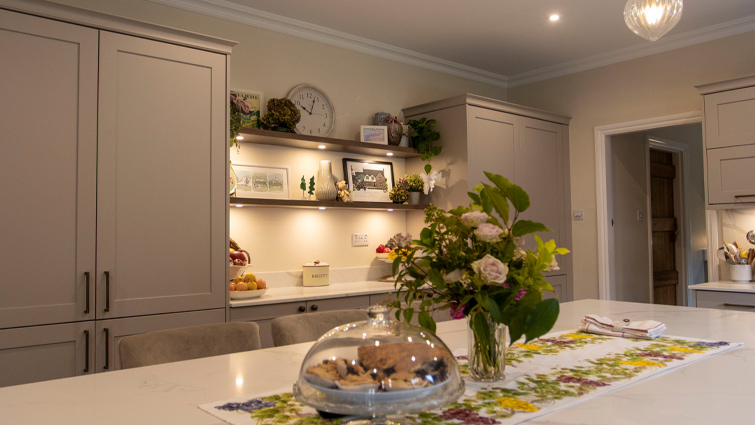
A Heritage Grey and New Forest Hardwick range by Sigma 3 Kitchens Swansea
After that, greige hit our Pinterest boards harder than that one Bake Off contestant “accidentally bumped” her rival’s cakes (we’re still enraged). We loved greige – again, too much – and, thus, greige eventually did the same as grey: plummett.
So, what new mega trend is coming and, importantly, how do you ride its popularity without becoming the next Icarus? Well, that’s what you’ll discover in today’s article about… mushroom kitchens.
Here at Masterclass Kitchens, we’ve watched thousands of customers choose warmer, yellower tones this year. In essence, beige is the new greige. And yes, while we love beige, it’s, well… beige. Nobody wants to sell their significant other on the kitchen equivalent of Ugg Boots and a flat white.
Nobody wants to be a basic pitch.
Fortunately, we have a solution: mushroom kitchens. A well-liked but more original alternative. A fun guy in a world of beige faces, if you will. But where did mushroom colour kitchens originate? Why will they work well in UK homes? And how can you create a mushroom kitchen? We have all the answers.
What is a Mushroom Kitchen?
Let’s be clear, we aren’t talking about colourful, fantasy-inspired mushroom décor. In this context, mushroom kitchens are a classier alternative to the newest kitchen design mega-trend: beige.
Specifically, the “mushroom” colour represents a soft brown-grey cabinetry with earthy undertones that the kitchen industry has adopted. It’s a taupe-like colour that works well within a neutral palette.
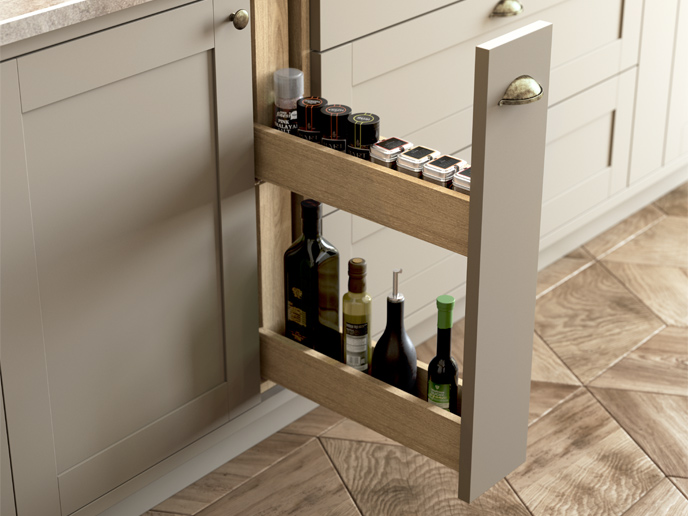
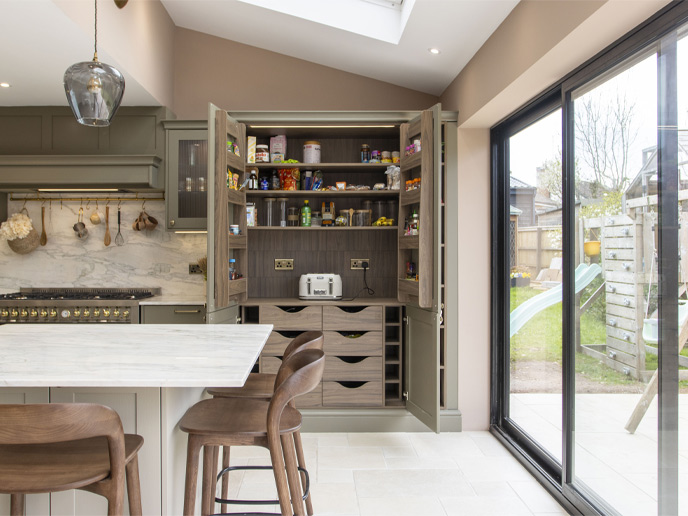
A Highland Stone MagnaSpace larder, and an Olive butler's pantry by Sigma 3 Kitchens Newport
Take, for instance, this Portland Oak pull-out spice larder, or this butler's pantry with Tuscan Walnut internal cabinetry, nestled amongst mushroom walls. Both harness the colour perfectly.
LOOKING FOR MORE INSPIRATION?
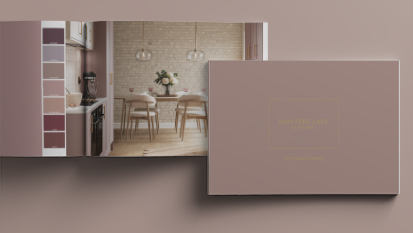
View Free Brochures & Access Exclusive Offers
Sign up to our newsletter for useful advice straight to your inbox.
How Did Mushroom Kitchens Appear?
It’s often joked about that the past was black and white, but in kitchen design, it was grey. Indeed, grey kitchens reigned supreme from around 2010 to 2020. This may seem unrelated but, in some ways, grey kitchens were the apes to mushroom kitchens’ homo sapiens. They’re linked by evolution.
.jpg)
.jpg)
A Scots Grey Hatfield kitchen by Sigma 3 Kitchens Cardiff East
At first, the greys seemed modern, clean, minimal – especially compared to wackier early 2000s tastes. In some homes, like this one with an elegant Scots Grey Hatfield range, great examples of greys persist today. However, as grey became omnipresent, the mainstream eventually craved a warmer aesthetic.
.jpg)
A Highland Stone Kensington range with a Scots Grey kitchen island by Sigma 3 Kitchens Cardiff West
Cue greige. Dominant from 2020 to 2023, greige mixed grey with beige, re-birthing Nancy Meyers’ warmth without fully committing to brown tones. In some ways, greige became a bridge colour that softened the barren feeling of grey but still felt modern.
Again, we still love greige. It looks fantastic in this Kensington setup, which uses brown leather barstools and mushroom walls to evoke warmth. Plus, it equally suits cooler grey tones. Even so, it seems homeowners and designers alike wanted to lean further into yellow undertones.
Mushroom Kitchens: A Classy Mega-Trend Alternative
Beige came next in 2024, the natural evolution of greige, and that brings us up to date. So, if you want to be on trend with the current iteration of “timeless palettes” (relative to less neutral colours) then beige is the way to go and, along with it, mushroom cabinets.
.jpg)
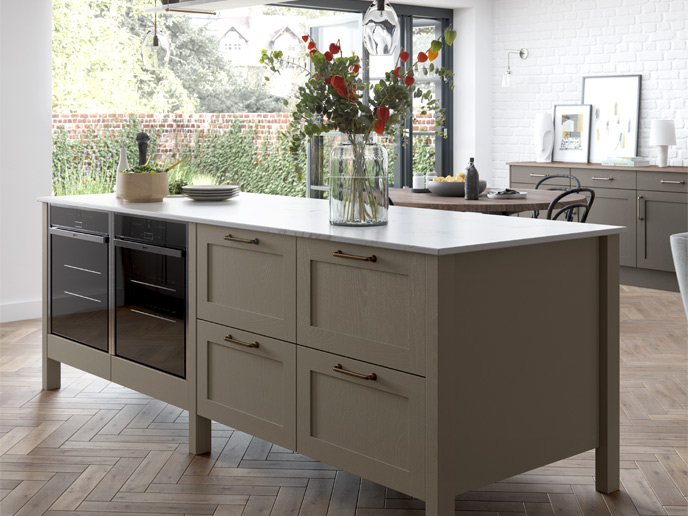
An Ashbourne range by Sigma 3 Kitchen Swansea and a Hardwick Highland Stone range
Why mushroom? In a lineup of yellowish facades, it provides a deeper parallel tone – similar enough to look on trend but different enough to stand out in a way that doesn’t stick out. It’s classy. Rich. More organic. It whispers “quiet luxury” in a way that matches old-money trousers and linen shirts.
Mushroom cabinet colours are ideal for those seeking a room that looks organic – one that’s analogue, that allows you to unplug from the world and enjoy flambéing a roast duck or cackling with friends over a bottle (or three) of merlot and a game of Pictionary. It’s ideal for settling the mind.
Why UK Homeowners Love Mushroom Kitchens
Most homes in the UK are designed to include living rooms with south-facing windows to brighten the most-used space. Kitchens, meanwhile, tend to be north facing because this setup inevitably positions them at the back of the house. Hence, cool tones often look colder than intended in UK kitchens.
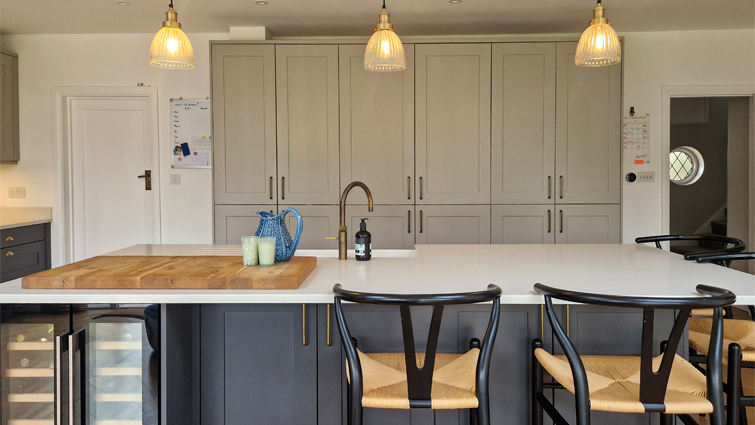
A Graphite and Farringdon Grey Marlborough range by Sigma 3 Kitchen Esher
Adorn a kitchen with mushroom cabinets and a complementary colourway, though, and you’ll inject warmth into the space, as thousands of UK homeowners have discovered. Mushroom cabinets have risen in popularity because they hit the sweet spot in low light: warm, not yellow; earthy, not brown.
Moreover, a mushroom colour kitchen palette has threefold benefits: it’s versatile for accessories, light enough to hide dust, and dark enough to camouflage rogue pasta sauce flecks. In essence, this colour makes your furniture high-end but is low maintenance for the overworked and time poor.
How to Create a Mushroom Kitchen
Mastering the mushroom-coloured kitchen actually requires less effort than you might imagine, given how much just a few simple choices can enhance a space’s air of comfort and sophistication.
1. Use a Warm, Layered Colourway
Choosing your overall palette in advance is vital because you can create a mushroom kitchen in two ways:
- Choose a brownish-grey cabinet colour like our Heritage Grey or Farringdon Grey, or
- Combine several colours and lighting highlights to create the impression of mushroom
Take, for instance, the following Highland Stone ranges for the latter method. Augmented with European paving or herringbone flooring, plus brown fittings and warm light, they create a mushroom aesthetic as a product of the ensemble, rather than as a result of an exact colour match in the cabinets.
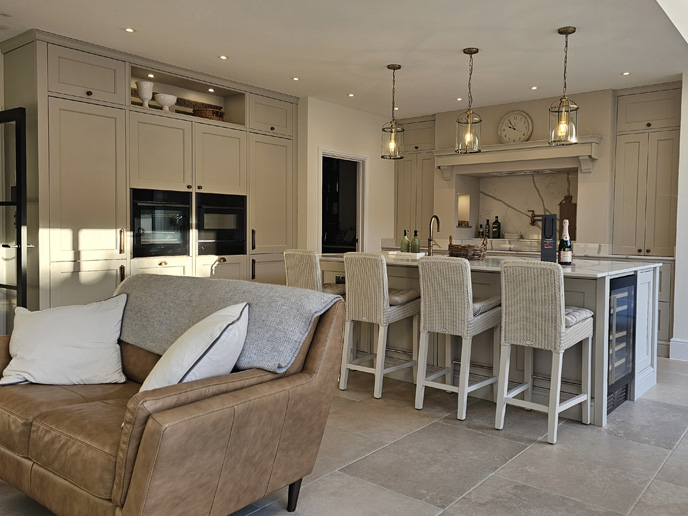
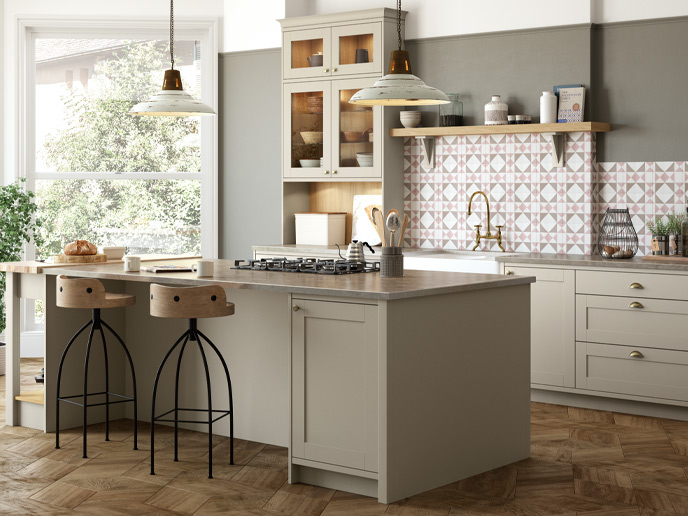
An Ashbourne range by Sigma 3 Kitchens Cardiff West and a Padstow range, both Highland Stone
The key is to avoid cold greys. Instead, consider browner stone, putty and clay tones. Natural is the watchword. Likewise, try brushed brass or aged bronze hardware. Both patina the overall look of what can sometimes be an otherwise all-too-clean kitchen, emphasising cosiness and nostalgia.
2. Select Natural Textures
Mushroom is an earthy colour. As such, it pairs best with organic textures. Think honed stone, veined quartz, oak, walnut, lines, rough plaster. All provide a cohesive look. And include green if you want a flare of pigment. Here at Masterclass, we’ve long praised the benefits of biophilic kitchens.
.jpg)
An Olive and Biscuit Hardwick kitchen by Sigma 3 Kitchens Newport
How do you integrate all these factors skilfully? Check out these drawers. Utilising Olive doors and rich Tuscan Walnut internal cabinetry, they form a seamless collage with the mushroom walls, creating the impression that the mushroom colour and its ethos were extended to the cabinets.
3. Pick a Classic Door Style
A subtle and organic colour, mushroom works best with classic and Shaker doors. This is because these two styles evoke a similar sense of traditionalism and nostalgia. You can incorporate more modern designs but that’s not advised. If you want to double down on the theme, traditional is the way to go.
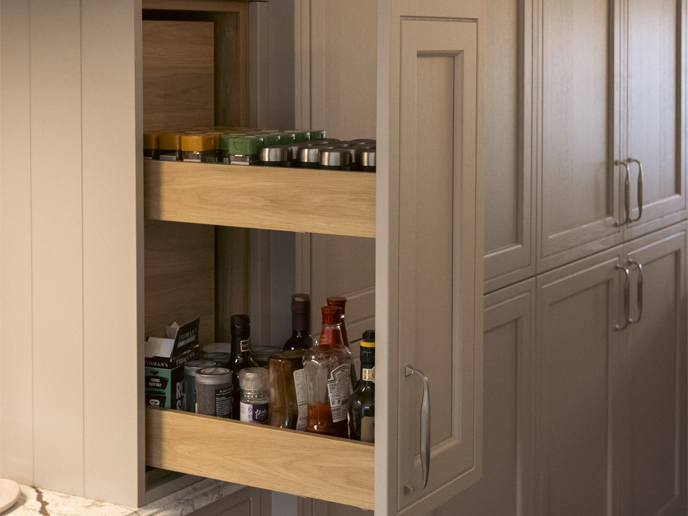
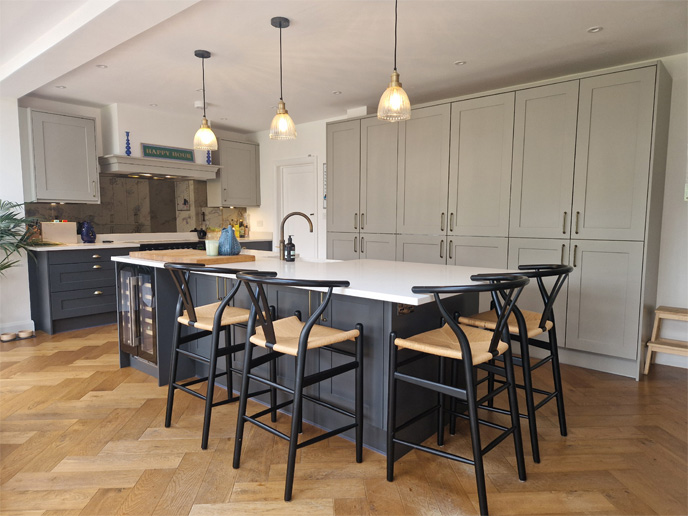
A Heritage Grey Hawksmoor pull-out larder by Sigma 3 Cardiff West
A Farringdon Grey Marlborough range by Sigma 3 Esher
Just remember to keep the lighting warm and use bold colours sparingly because overwhelming modernity and gaudiness are the antithesis of the mushroom kitchen ethos. The last thing you want to do is drown out the elegant, classic feel of a mushroom kitchen with new-money flash.
Need a Mushroom Kitchen Designer?
Take onboard all the guidelines in this article and you’ll create a wonderful mushroom kitchen. If you need more help, though, request our Masterclass Kitchens brochures. Available as digital downloads or luxury coffee table catalogues, they cover all the inspiration you’ll need. Also, why not find your nearest showroom and book a meeting with a seasoned expert?